Side effects
Injection Site Reactions: What's Normal, What's Not
Last clinically reviewed: July 21, 2026 by Dr. Prajeet Reddy, MD (Medical Director)
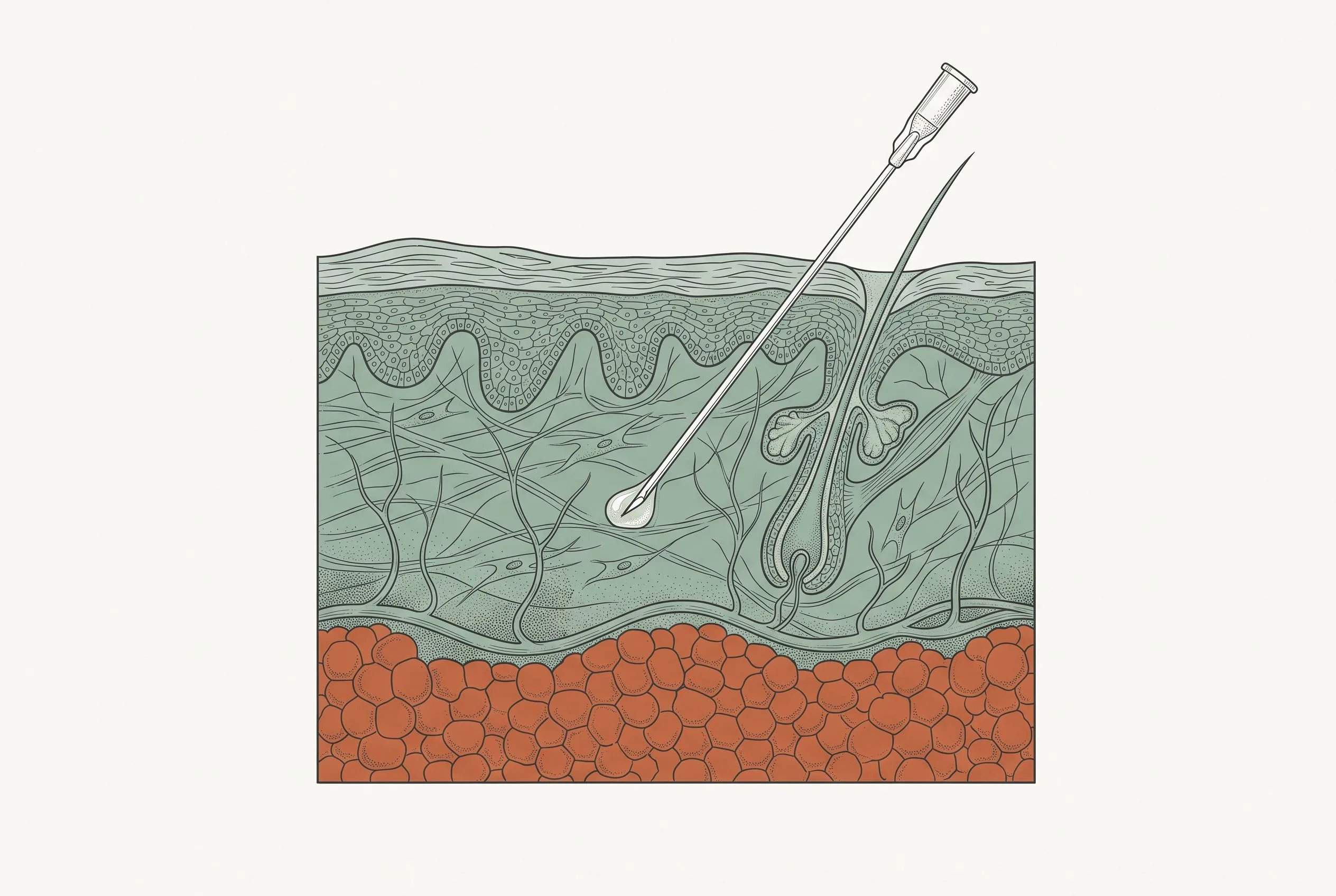
GLP-1 medications (semaglutide/Ozempic/Wegovy, tirzepatide/Mounjaro/Zepbound, dulaglutide/Trulicity, liraglutide/Saxenda/Victoza) are given as a shot just under the skin — usually in the abdomen, thigh, or upper arm.[5]
What Is an Injection Site Reaction?
Any skin change or discomfort at or near where you gave your shot. These are common and usually mild.[3] They may include:
- Redness (erythema)
- Pain or tenderness
- Itching
- Swelling or a small lump (nodule)
- Bruising
Most go away on their own within a few days and don't mean you need to stop your medication.[1][3]
How Common Are They?
Injection site reactions occur in roughly 1–5% of patients using semaglutide or liraglutide, and somewhat more with dulaglutide or exenatide.[2] A large review of 14 clinical trials found these reactions are about 3.5 times more common with GLP-1s than with placebo, but the vast majority are mild and resolve without treatment — and rarely require stopping the medication.[1]
How to Reduce Injection Site Reactions
- Rotate your injection sites (see below).[4]
- Let the pen warm up slightly — remove it from the fridge about 30 minutes before injecting.[5]
- Use a new needle for every injection (for pens that require separate needles).[5]
- Insert the needle straight in at a 90-degree angle unless your provider tells you otherwise.[3]
- Do not inject into skin that is bruised, red, tender, hard, or scarred.[4]
- Inject slowly — after pressing the dose button, hold the needle in and count slowly to 6 (or until you hear a click, depending on your pen) before removing it.[5]
- Do not rub the injection site afterward.
How to Properly Rotate Your Injection Sites
Rotating where you inject is one of the most important things you can do to prevent reactions, skin changes, and lumps.[4][3]
Step 1: Choose from three body areas[5][4]
- Abdomen (belly): at least 2 inches from your belly button; avoid the waistline. The abdomen is generally preferred because it has more fatty tissue and may cause less pain and bruising.
- Upper thigh (front): the fleshy area on the front, about halfway between hip and knee.
- Upper arm (back): the fleshy area on the back of your upper arm (may require help from another person).
Step 2: Rotate between areas — move to a different body area with each injection. For example: Week 1 left abdomen, Week 2 right thigh, Week 3 right abdomen, Week 4 left thigh, then repeat.
Step 3: Rotate within each area — each time you return to an area, choose a spot at least 1 inch from your last injection there.[4] Think of each area as a clock face and move to a new "hour" each time.
Tip: keep a simple log or use a calendar to note which site you used each week.
Managing a Mild Reaction at Home
If you notice mild redness, swelling, or discomfort:[3]
- Apply a clean, cool compress (a cold pack wrapped in cloth) for 10–15 minutes.
- An OTC pain reliever (acetaminophen or ibuprofen) may help with soreness.
- Do not scratch itchy areas — a cool compress helps with itching too.
- The reaction should improve within a few days.[1]
When to Contact Your Provider
Call your doctor or care team if you experience:
- Redness, swelling, or pain that is getting worse or hasn't improved after several days
- A hard lump that is growing or very painful
- Signs of infection: warmth, increasing redness, pus or drainage, or fever
- A rash or hives that spreads beyond the injection site
- Difficulty breathing, swelling of the face/lips/tongue, or feeling faint — these could be signs of a serious allergic reaction. Call 911 or go to the emergency room immediately.
Key Reminders
- Injection site reactions are common and usually mild — not a sign the medication isn't working.[3]
- Proper site rotation is the single best way to prevent reactions and skin changes.[4]
- Never inject the same exact spot twice in a row.
- Always use a new needle for each injection.[5]
- Talk to your provider if you have any concerns about your injections.
Frequently asked questions
What does a normal GLP-1 injection site reaction look like?
Redness, pain or tenderness, itching, a small lump or nodule, or bruising at or near where you injected. These are common, usually mild, and most go away on their own within a few days. They don't mean you need to stop your medication or that it isn't working.
How do I rotate my injection sites correctly?
Use three areas — abdomen (at least 2 inches from the belly button), front of the upper thigh, and back of the upper arm — and move to a different area with each weekly injection. When you return to an area, pick a spot at least 1 inch from where you last injected there. Think of each area as a clock face and move to a new 'hour' each time. Never inject the same exact spot twice in a row.
How can I reduce injection site reactions?
Rotate sites, let the pen warm up (remove from the fridge about 30 minutes before), use a new needle every time, insert straight in at a 90-degree angle unless told otherwise, avoid bruised/red/tender/hard/scarred skin, inject slowly, and don't rub the site afterward. For a mild reaction, a cool compress for 10–15 minutes and an OTC pain reliever can help.
When is an injection site reaction serious?
Call your provider for redness, swelling, or pain that's worsening or hasn't improved after several days; a hard lump that's growing or very painful; or signs of infection (warmth, spreading redness, pus, fever). Go to the ER or call 911 for difficulty breathing, swelling of the face, lips, or tongue, feeling faint, or a rash/hives spreading beyond the site — these can signal a serious allergic reaction.
Sources
- Injection-Site and Dermatologic Reactions Associated With GLP-1 RAs: Meta-Analysis — Taj et al., Diabetes Obes Metab 2026
- GLP-1 Receptor Agonists in Type 2 Diabetes: Are They All the Same? — Gentilella et al., Diabetes Metab Res Rev 2019
- Injection Site Reactions With the Use of Biological Agents — Thomaidou & Ramot, Dermatol Ther 2019
- WEGOVY Prescribing Information — DailyMed (FDA)
- Use of GLP-1 RAs in Patients With Type 2 Diabetes and Cardiovascular Disease — Honigberg et al., JAMA Cardiol 2020
This article is for education and does not replace your prescriber’s instructions or the FDA Medication Guide that comes with your medication. Clinical content reviewed by Dr. Prajeet Reddy, MD, Medical Director (Cyane Medical Group California PC).
$29/mo membership — the lowest in GLP-1 telehealth. No contracts.