Medications
Zepbound Vials: How to Draw Up and Inject With a Syringe
Last clinically reviewed: August 1, 2026 by Dr. Prajeet Reddy, MD (Medical Director)
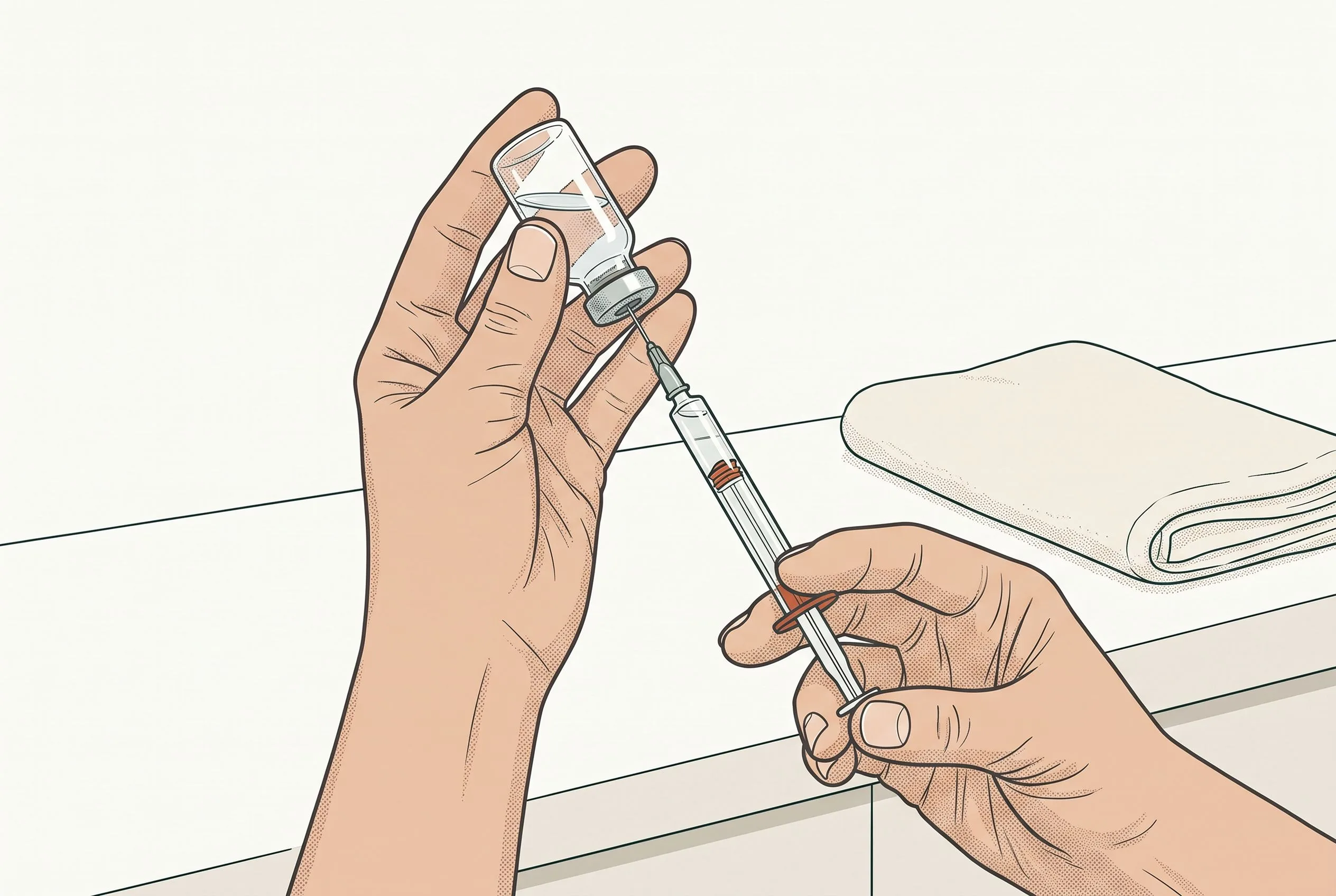
Zepbound single-dose vials each hold 0.5 mL of clear, colorless-to-slightly-yellow liquid — exactly one weekly dose. Vials come in six strengths (2.5, 5, 7.5, 10, 12.5, and 15 mg), all in the same 0.5 mL volume.[1]
This matters: because every strength is 0.5 mL, you draw the full 0.5 mL regardless of your dose. The dose is determined by which vial you were prescribed, not how much you draw. Check the strength on the label against your prescription every single time.
Single-dose vials contain no preservative. Use a vial once and discard it, even if liquid remains — never save leftover medication, and never share a vial.[1]
Switching formats? The Zepbound multi-dose vial and KwikPen deliver 0.6 mL per dose, not 0.5 mL. If your pharmacy switches you between formats, ask your clinician or pharmacist to re-train you before your next injection — the FDA label specifically calls for training on each new presentation.
Supplies for Each Injection
You need a new, sterile syringe and needle every time — typically a 1 mL syringe capable of measuring 0.5 mL:[1]
- One Zepbound single-dose vial (correct strength, not expired)
- One new sterile 1 mL syringe with a needle for subcutaneous injection
- Two alcohol wipes (one for the vial top, one for your skin)
- A clean cotton ball or gauze
- An FDA-cleared sharps container
Use the needle your prescriber or pharmacist provided — the exact gauge and length are in the Instructions for Use leaflet in your carton. Don't substitute a needle meant for a different route (such as an intramuscular needle).
Drawing Up Your Dose
- Wash your hands and work on a clean, flat, well-lit surface.
- Check the vial — strength matches your prescription, expiration date hasn't passed.
- Inspect the liquid — clear, colorless to slightly yellow. Particles or an off color mean don't use it.
- Optional: let it warm up. Taking the vial out of the fridge 15–30 minutes early is a comfort measure only. Never warm it in a microwave, hot water, or sunlight.
- Clean the stopper. Flip off the plastic cap, wipe the rubber stopper with an alcohol wipe, and let it air dry completely.
- Prepare the syringe. Unwrap it without touching the needle or hub. Pull the plunger back to draw 0.5 mL of air.
- Inject the air into the vial. With the vial upright, push the needle straight through the stopper's center and press the plunger. This equalizes pressure and makes drawing easier.
- Withdraw the medication. Leaving the needle in, turn the vial upside down. Keep the needle tip below the liquid level and slowly pull the plunger until its edge lines up with the 0.5 mL mark.
- Clear air bubbles. Tap the barrel so bubbles rise, push them back into the vial, and re-draw to exactly 0.5 mL of liquid — no visible bubble.
- Remove the needle from the vial and set the syringe down without letting the needle touch anything. Don't recap it.
Giving the Injection
- Choose your site. Abdomen (2+ inches from the navel) or the front/outer thigh. The back of the upper arm may only be used if someone else injects for you.[1] Avoid bony areas, scars, stretch marks, moles, and skin that's bruised, tender, red, hard, or broken.
- Rotate with every dose — for example, four quadrants of the abdomen, or abdomen and thighs on alternating weeks. Injection site reactions occurred in roughly 3–6% of patients in SURMOUNT-1, none severe.[2] Our site-reaction guide covers rotation in detail.
- Clean the skin with a fresh alcohol wipe and let it air dry. Don't touch the cleaned spot again.
- Pinch and insert. Pinch up a fold of skin and fat, insert the needle at 90 degrees (45 if you're thin with a longer needle), fully in, so the medicine lands in fat rather than muscle.
- Inject slowly. Release the pinch, then press the plunger steadily until empty — about 5–7 seconds.
- Hold, then withdraw. Keep the plunger down about 2 seconds, then pull straight out. This limits leak-back.
- Aftercare. A drop of blood? Press lightly with gauze — don't rub. Tiny leakage or a small bruise is common and doesn't mean you lost a meaningful amount of medicine. Never re-inject to "make up" for it.
Sharps Disposal
Drop the used syringe and needle — together, uncapped — into your sharps container immediately. Never recap, bend, or cut a needle; recapping is when most accidental needlesticks happen.[5]
If you don't have an FDA-cleared container, a heavy-duty puncture-resistant plastic container (a laundry detergent bottle, not a milk jug or soda bottle) with a tight lid, kept upright and labeled, works temporarily. When nearly full, follow your local disposal rules — pharmacy drop-off, mail-back, or hazardous-waste collection, depending on your area. The empty glass vial itself is not a sharp and can generally go in household trash.
Storage
| Situation | What to do |
|---|---|
| Normal storage | Refrigerate at 36–46°F (2–8°C) |
| Out of the refrigerator | Up to 86°F (30°C) for a maximum of 21 days total — then discard, even if unused |
| Frozen | Never freeze. Discard any vial that has frozen, even after thawing |
| Light and heat | Keep in the original carton, away from heat |
| After use | Discard immediately after one dose |
The 21-day room-temperature window is cumulative, not resettable: 10 days out, back in the fridge, then 11 more days out uses up the full 21. Note this differs from the KwikPen and multi-dose vial, which follow a 30-day rule. Full details in our storage guide.
For travel: carry vials in their carton in your carry-on — cargo holds can freeze. An insulated bag with a cold pack works; keep vials from touching the cold pack directly.
Timing and Missed Doses
Take Zepbound once weekly, any time of day, with or without food. If you miss a dose:
- Within 4 days (96 hours): take it as soon as you remember, then return to your usual day.
- More than 4 days: skip it entirely and take your next dose on schedule. Never double up.
To change your injection day, leave at least 3 days (72 hours) between doses.[1] See the missed-dose guide for every GLP-1's rules.
Dosing typically starts at 2.5 mg weekly for 4 weeks, then increases in 2.5 mg steps toward a maximum of 15 mg. Each dose change means a new vial strength — double-check the label. Full schedule in our Zepbound dosage guide.
When to Call Your Provider
Stop and call right away for:
- Severe stomach pain, especially spreading to your back — possible pancreatitis
- Face, lip, tongue, or throat swelling, trouble breathing, or severe rash — seek emergency care
Call promptly for:
- A neck lump or swelling, persistent hoarseness, trouble swallowing, or shortness of breath — Zepbound carries a boxed warning about thyroid C-cell tumors seen in rats and should not be used with a personal or family history of medullary thyroid cancer or MEN 2
- Upper-right abdominal pain, particularly after eating — possible gallbladder problem
- Nausea, vomiting, or diarrhea that won't stop — dehydration is the main path to kidney injury on tirzepatide; sip fluids steadily and call before you become depleted
- Vision changes, if you have diabetes[1]
Also tell your care team: before any surgery or procedure with anesthesia (GLP-1s slow stomach emptying); if you take insulin or a sulfonylurea (hypoglycemia risk — keep fast-acting sugar available); if you use birth control pills (add a barrier or non-oral method for 4 weeks after starting and after each dose increase); and if you are pregnant, trying to become pregnant, or breastfeeding.[1]
What to Expect
Stomach-related side effects are the most common and usually mild to moderate: in SURMOUNT-1, nausea affected about 25–33%, diarrhea 19–23%, constipation 12–17%, and vomiting 8–12%, depending on dose.[2] Symptoms cluster around dose increases and settle afterward — in pooled SURPASS analyses, GI symptoms peaked as each group finished dose escalation, then declined substantially.[3] Smaller portions, stopping when full, avoiding greasy foods, and steady hydration all help. If side effects are limiting, staying longer at your current dose is a reasonable option to raise with your prescriber.[4]
Frequently asked questions
How much do I draw up from a Zepbound vial?
Always the full 0.5 mL. Every single-dose vial strength — 2.5, 5, 7.5, 10, 12.5, and 15 mg — comes in the same 0.5 mL volume, so your dose is determined by which vial strength you were prescribed, not by how much liquid you draw. Check the strength printed on the vial against your prescription every time, especially after a dose increase.
What if there are air bubbles in the syringe?
With the vial still inverted and the needle in the stopper, tap the syringe barrel so bubbles rise toward the needle, push them back into the vial, and re-draw to exactly 0.5 mL. Small bubbles aren't dangerous in a subcutaneous injection, but they take up space — injecting with a bubble means you get less than your full dose.
Can I save leftover liquid in a Zepbound vial for later?
No. Single-dose vials contain no preservative and are used once, then discarded — even if some liquid remains. Never save leftovers for a future dose, never combine partial vials, and never use a vial for anyone but yourself.
What angle do I inject Zepbound at?
Pinch up a fold of skin and insert the needle at 90 degrees for most people (45 degrees if you're thin and using a longer needle), so the medicine reaches the fat layer rather than muscle. Press the plunger steadily over about 5–7 seconds, hold for about 2 seconds, then pull straight out. Don't rub the site afterward.
Sources
- Zepbound Prescribing Information — DailyMed (FDA)
- Tirzepatide Once Weekly for the Treatment of Obesity (SURMOUNT-1) — Jastreboff et al., N Engl J Med 2022
- Gastrointestinal adverse events with tirzepatide in the SURPASS trials — Patel et al., Diabetes Obes Metab 2024
- Continued Treatment With Tirzepatide for Maintenance of Weight Reduction (SURMOUNT-4) — Aronne et al., JAMA 2024
- Safely Using Sharps at Home, at Work and on Travel — FDA
This article is for education and does not replace your prescriber’s instructions or the FDA Medication Guide that comes with your medication. Clinical content reviewed by Dr. Prajeet Reddy, MD, Medical Director (Cyane Medical Group California PC).
$29/mo membership — the lowest in GLP-1 telehealth. No contracts.