Medications
Switching From Compounded Semaglutide to Brand-Name Medication
Last clinically reviewed: September 24, 2026 by Dr. Prajeet Reddy, MD (Medical Director)
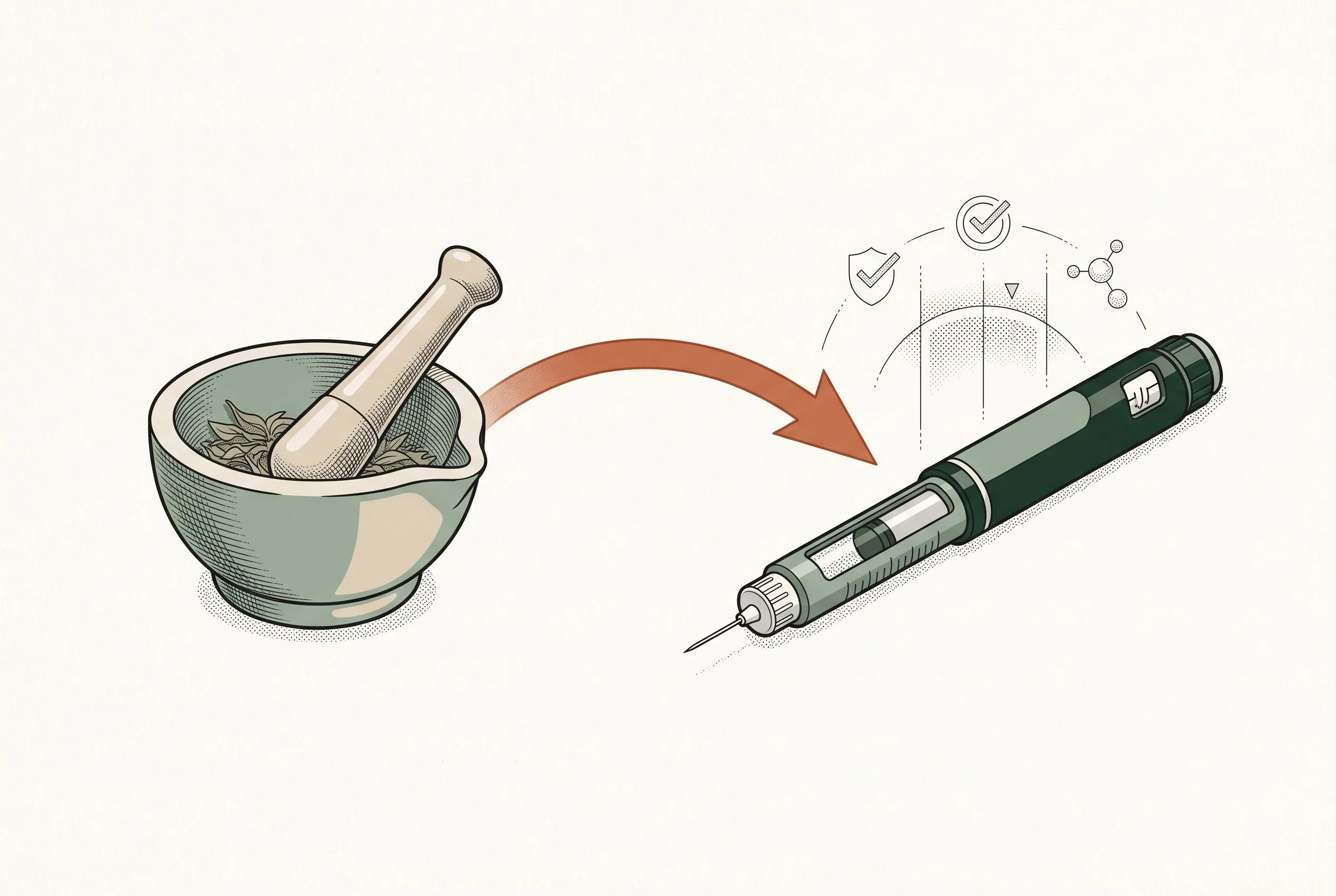
If you've been using a compounded copy of semaglutide or tirzepatide — made by a pharmacy rather than the manufacturer — and your care team is moving you to the FDA-approved, brand-name version, here's what changes and why.
| Active ingredient | Brand name for weight management | Diabetes brand (same drug) |
|---|---|---|
| Semaglutide | Wegovy | Ozempic |
| Tirzepatide | Zepbound | Mounjaro |
Why Compounded Copies Are Being Phased Out
Pharmacies are allowed to make copies of drugs that are on the FDA's shortage list. Semaglutide and tirzepatide were in short supply during 2022–2024, and compounded copies became widely available. Those shortages have ended — the FDA resolved the tirzepatide shortage in December 2024 and the semaglutide shortage in February 2025 — so compounded copies are being phased out and the FDA-approved versions are available again.[1]
Why the FDA-Approved Version Is Safer
The most important difference is simple: compounded drugs are not reviewed or approved by the FDA. Nobody checks them for safety, strength, purity or effectiveness before they're sold. That has led to real, documented problems:[2]
- Dosing mistakes are the biggest risk. Compounded products often come in a multi-dose vial that you measure yourself with a syringe. Many people have accidentally drawn up far more than their prescribed dose — in some cases 10 times too much — leading to severe vomiting, dehydration, and hospital visits. One poison control center logged over 300 calls, and about 4 in 10 callers needed a hospital.
- The strength may not match the label. Testing has found compounded products with the wrong amount of drug and with impurities not found in the approved versions.
- Different forms of the drug. Some compounders used salt forms (semaglutide sodium or acetate) that are not the same ingredient as the FDA-approved drug, with unknown effects.
- Contamination risk. Some pharmacies making these products were not properly licensed for sterile compounding.
- Extra additives. Some compounded mixes add ingredients such as B12 or L-carnitine that have not been proven safe or effective in these combinations.
Major medical societies recommend FDA-approved obesity medications for exactly these reasons.[3][4] More on the differences: brand-name vs compounded GLP-1s.
What Will Be Different Day to Day
The device. Brand-name devices deliver a fixed, labeled dose — there's no measuring out a custom amount:
| Product | Device | What you do |
|---|---|---|
| Wegovy | Single-dose pre-filled pen | Nothing to draw up or dial — one pen, one dose (how to inject) |
| Zepbound vial | Single-dose vial + syringe | Each vial holds exactly one dose; you always draw the full 0.5 mL (how to inject) |
| Zepbound KwikPen | Four-dose pen | Dial and inject one dose per week (how to use) |
The Zepbound vial still uses a syringe, but unlike a compounded vial, your dose is set by which vial strength you're prescribed — every strength comes in the same 0.5 mL volume, so there's no calculation.[6]
How you inject. Still once weekly, under the skin of your abdomen, thigh, or upper arm. Rotate the spot each week. Any time of day, with or without food. Pick one day and stick to it.
Storage. Keep brand-name pens and vials in the refrigerator. A Wegovy pen can be kept at room temperature for up to 28 days; a Zepbound single-dose vial for up to 21 days in total.[5][6] Full limits for every product: GLP-1 storage rules.
What Dose Will You Start On
Because the true strength of a compounded product can't be verified, your prescriber may restart you at a standard, lower dose and build up again. This is the safest approach and lowers the chance of stomach side effects. Don't assume your new dose will match your old one — follow your prescriber's specific instructions.
The standard step-up schedules are below. Your prescriber may adjust these for you.
Wegovy (semaglutide), once weekly:[5]
| Weeks | Weekly dose |
|---|---|
| 1–4 | 0.25 mg |
| 5–8 | 0.5 mg |
| 9–12 | 1 mg |
| 13–16 | 1.7 mg |
| 17+ | 2.4 mg (usual maintenance) |
A higher 7.2 mg maintenance dose was FDA-approved in March 2026 for some adults with obesity; in the STEP UP trial it produced more weight loss than 2.4 mg, with more stomach side effects.[7][8]
Zepbound (tirzepatide), once weekly:[6]
| Weeks | Weekly dose |
|---|---|
| 1–4 | 2.5 mg |
| 5–8 | 5 mg |
| 9–12 | 7.5 mg |
| 13–16 | 10 mg |
| 17–20 | 12.5 mg |
| 21+ | 15 mg (maximum) |
If a dose is hard to tolerate, your prescriber may keep you at that step longer before increasing. The goal is the lowest dose that works for you. Full schedules: Wegovy and Zepbound.
Side Effects to Expect
The most common side effects of both medicines involve the stomach and gut, especially when starting or increasing the dose: nausea, diarrhea, vomiting, constipation, stomach pain, and indigestion. They're usually mild to moderate and often improve with time.[5][6]
To feel better:
- Eat smaller meals, and eat slowly
- Avoid greasy, fried, or very fatty foods
- Limit alcohol and fizzy drinks
- Drink enough water and get enough fiber
- Ask your prescriber about anti-nausea medicine if nausea is severe
More: managing nausea on GLP-1s.
If You Miss a Dose
- Wegovy: if your next dose is more than 2 days (48 hours) away, take the missed dose as soon as you can. If it's less than 2 days away, skip it and take your next dose on your regular day.[5]
- Zepbound: take a missed dose within 4 days (96 hours). Past that, skip it and take the next one on your regular day. Always leave at least 3 days between doses.[6]
- If you've missed 2 or more weekly doses in a row, or been off for several weeks, don't restart at your old dose — check with your prescriber, who will likely have you begin lower again.
Full rules: missed GLP-1 dose.
When to Call Your Prescriber Right Away
Contact your care team or seek urgent care if you have:
- Severe or non-stop vomiting or diarrhea, or signs of dehydration
- Severe stomach pain that won't go away, especially pain spreading to your back — a possible sign of pancreatitis
- Pain in the upper right belly, fever, or yellowing of the skin or eyes — a possible gallbladder problem
- Signs of a serious allergic reaction — trouble breathing, swelling, severe rash
Questions to Ask at Your Next Visit
- What is my exact starting dose and step-up plan on the brand-name medication?
- How do I use and store my pen or vial correctly?
- What should I do if side effects make it hard to continue?
- How and when will we check that the new medication is working?
The Short Version
Compounded semaglutide and tirzepatide aren't FDA-reviewed, and the shortages that allowed them have ended. Brand-name Wegovy and Zepbound deliver a fixed, labeled dose, so the measuring errors that sent compounded users to the hospital go away. Expect your prescriber to restart you at a standard low dose and step up every 4 weeks, and expect some stomach side effects early on that usually ease.
Frequently asked questions
Can I switch from compounded semaglutide to Wegovy at the same dose?
Don't assume so. The true strength of a compounded product can't be verified, so your prescriber will often restart you at a standard lower dose and step up every 4 weeks — the safest approach and the one least likely to cause stomach side effects. Follow your prescriber's specific instructions rather than matching your old dose.
Why is compounded semaglutide being phased out?
Pharmacies are allowed to make copies of drugs that are on the FDA's shortage list. Semaglutide and tirzepatide were in shortage during 2022–2024; the FDA resolved the tirzepatide shortage in December 2024 and the semaglutide shortage in February 2025, so compounded copies are being phased out and the FDA-approved versions are available again.
Is brand-name Wegovy safer than compounded semaglutide?
Brand-name Wegovy and Zepbound are FDA-reviewed for safety, strength, purity and effectiveness; compounded copies are not. Documented problems with compounded products include dosing mistakes when patients measure doses from a vial themselves, products with the wrong amount of drug, salt forms that aren't the approved ingredient, and additives that haven't been proven safe in these combinations.
Will I have side effects when I switch to the brand-name version?
You may, especially if you restart at a low dose and step back up. The most common side effects of both medicines are stomach-related — nausea, diarrhea, vomiting, constipation, stomach pain and indigestion — and they're usually mild to moderate and ease over time. Smaller meals, avoiding greasy food, and staying hydrated help.
Sources
- FDA Clarifies Policies for Compounders as National GLP-1 Supply Begins to Stabilize — U.S. Food and Drug Administration
- Patients Are Flocking to Compounded Weight-Loss Drugs, but Are They Safe? — Ruder, JAMA 2025
- AACE Consensus Statement: Evaluation and Treatment of Adults With Obesity — Endocrine Practice 2025
- 2025 Concise Clinical Guidance: ACC Expert Consensus Statement on Medical Weight Management — Gilbert et al., JACC 2025
- WEGOVY Prescribing Information (injection and tablets) — DailyMed (FDA)
- Zepbound Prescribing Information — DailyMed (FDA)
- FDA Approves Higher-Dose Injectable Semaglutide — Anderer, JAMA 2026
- Once-Weekly Semaglutide 7.2 mg in Adults With Obesity (STEP UP) — Wharton et al., Lancet Diabetes Endocrinol 2025
This article is for education and does not replace your prescriber’s instructions or the FDA Medication Guide that comes with your medication. Clinical content reviewed by Dr. Prajeet Reddy, MD, Medical Director (Cyane Medical Group California PC).
$29/mo membership — the lowest in GLP-1 telehealth. No contracts.